A Note Before You Read This post contains content that may be upsetting, distressing, and may trigger a trauma response. If you are a survivor of abuse, have been a victim of the abuse of power, or have been traumatized by horrific experiences while traveling, please proceed with caution. The information contained in this post is intentionally limited to protect vulnerable individuals.
The Day Before the Flight
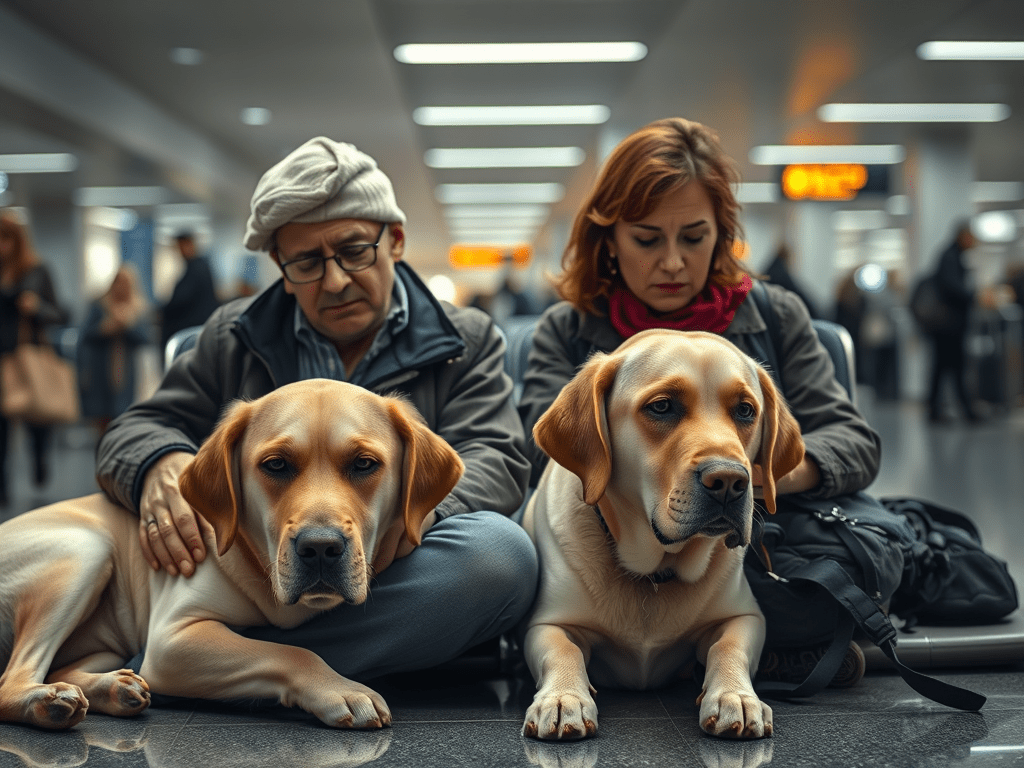
The first ripple of frustration appeared not on the day of travel, but the day before. As my partner and I attempted to check in for our flight, an electronic error blocked our path, a vague message telling us to “try again later.” I knew something was wrong. I couldn’t shake the feeling that this wasn’t just a technical glitch; it was another hurdle, another reminder of the systemic barriers we so often face. A call to WestJet confirmed my fears. I was told, with no logical explanation, that we couldn’t check in electronically because of our service dogs. The reason? A ticket agent needed to “observe the dogs” at the counter.
It was an absurdity that deflated me. For years, my partner and I have traveled with our service dogs, and we know the policies. The supervisor I spoke with was less than helpful, essentially reciting a policy that didn’t exist, a policy that had never been applied equitably. My partner had flown with the same airline and experienced this exact issue, yet I had not. The inconsistency was maddening, a clear sign that this wasn’t a policy at all—it was a discretionary, frustrating, and, frankly, discriminatory practice.
The Day of the Flight: A Gauntlet
The next morning, we arrived at the airport feeling defeated before we even began. The first challenge was simply finding the check-in counter. In a vast, impersonal space, we were met with shrugs and vague directions that felt less like assistance and more like active obstruction. We were, thankfully, eventually pointed in the right direction by a kind soul at another counter. Our relief was short-lived, however. We had not yet faced the crucible of airport security.
I truly believe that for those in airport security, particularly in Edmonton, communication is a lost art. A security agent approached my partner, attempting to physically guide her without a word. The assumption that those with disabilities need to be manhandled, that our bodies are public property, is dehumanizing and exhausting. We waited for what felt like an eternity, receiving zero direction, until my frustration broke. I began to walk toward a counter, desperate for an end to the confusion. A guard finally shouted at me, “Go to lane 5!” but when I asked where that was, he simply pointed and said, “Over there.” Meanwhile, my partner was left to fend for herself, stranded and invisible until another agent finally stepped in.
As we went through the security screening, the familiar ritual of being treated like criminals began. Everything had to be separated: laptops, liquids, personal belongings. But for those with service dogs, the humiliation goes a step further. We are always, without exception, subjected to a secondary search—wanded and swabbed like we’ve committed a crime, while others are permitted to walk through with ease. As my partner was re-collecting her belongings, I was still being searched, as security debated whether my dog’s treat pouch was a threat. My frustration boiled over. If it’s part of my dog’s equipment, it doesn’t leave my side.
The Gate & The Flight: The Final Blow
Feeling completely drained and utterly exhausted, we finally made it to our gate, hoping for a moment of peace. As I went to grab a coffee and a donut, I returned to a scene that would crush any remaining hope. Across from us, a family sat. I was consuming a donut and coffee, attempting to find a moment of peace, when I heard it. Slap. A mother, in a moment of pure cruelty, slapped her child in public. My heart sank. What followed was a torrent of verbal abuse, a sickening display of anger and control. I was stunned into silence, a feeling of helplessness washing over me. Exhausted and defeated from the morning’s struggles, all I could do was sit there, paralyzed by the horrific display.
The abuse continued throughout the flight. The sounds, the fear in the children’s eyes, and my own profound sense of powerlessness haunted me for every agonizing minute of the flight. My partner was surprised that the police were not waiting for us on the other end, but by then, I was too emotionally and physically drained to care. I just wanted to escape.
The Aftermath: A Call to Action
After managing to get some food and process the events, a cold, hard resolve set in. I called the Regina Police Services to report the abuse, but the encounter was as dismissive as the airline’s. They barely took enough information to investigate and left me with the cold promise that “an officer would be in touch if they wanted to take this further.” The children were not protected, and I felt utterly betrayed.
My partner called WestJet to address the abuse, and to their credit, the customer service team was genuinely concerned. But my frustration with them was not over. We were transferred to the “Special Care Desk” to discuss the service dog policy, and this is where my final hope for a reasonable explanation was shattered. When I asked for the logic behind the policy, they offered no answer, only a repetition of a phrase that felt like a deliberate insult: “That’s just how the program works.” It was a slap in the face. It was the moment I realized they were not interested in understanding how their policies rob us of our independence and dignity.
This trip was a brutal reminder that, as persons with disabilities, our rights are an afterthought. Corporate policies and a lack of empathy continue to treat us as second-class citizens, a problem that extends far beyond one airline. I am tired of being pushed around, and so, following this post, I will be filing a formal complaint with the Canadian Transport Agency (CTA). The time for polite requests and frustration is over. The time for demanding our dignity and rights is now. Bus travel is looking real appealing at this point.
Need Support?
- In Canada: The Hope for Wellness Helpline offers free, confidential support for all Indigenous peoples across Canada. Phone: 1-855-242-3310.
- In the United States: The National Suicide Prevention Lifeline is available 24/7 at 988.
- General Support: Please reach out to your local crisis centre, mental health hotline, or seek professional help if you or someone you know is in distress. You are not alone.
 Unapologetically Blind