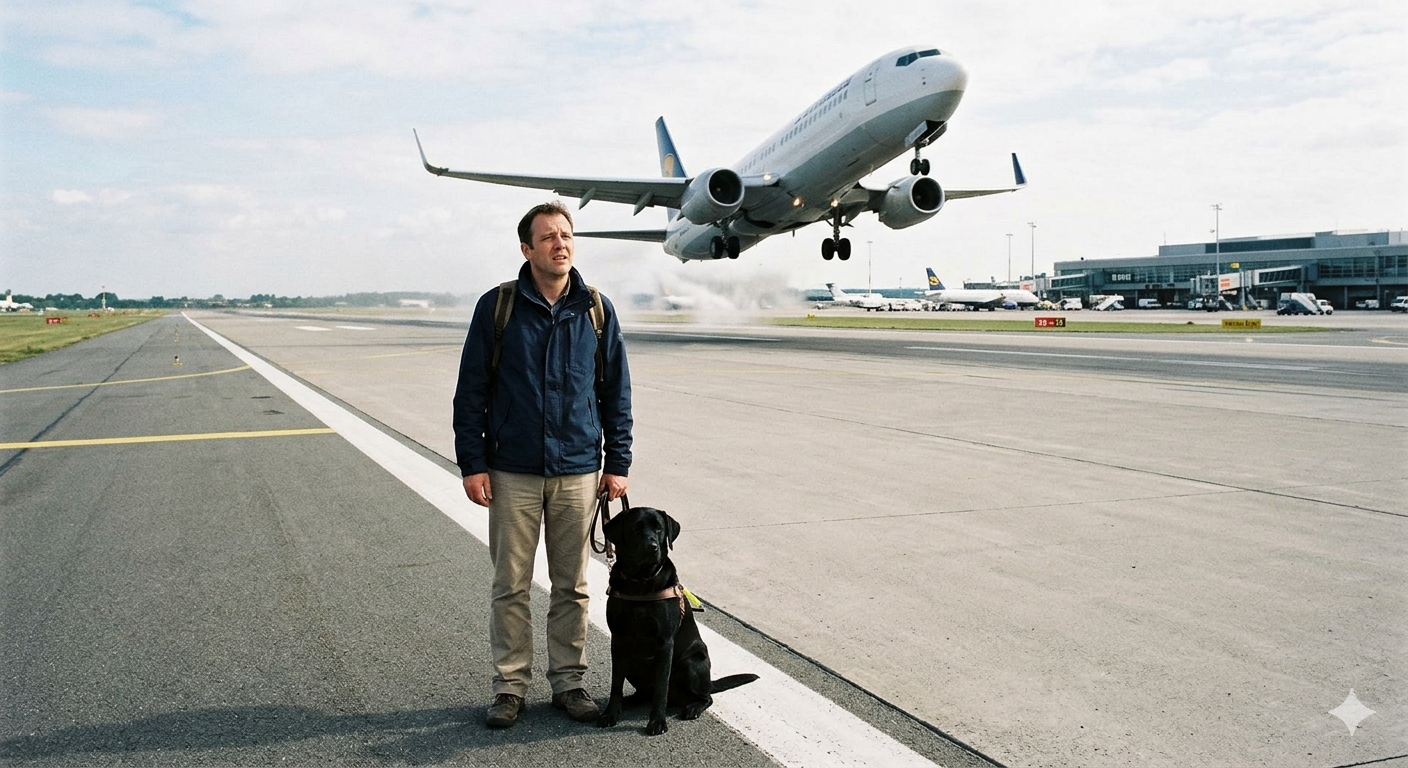
Tag: animosity

  • Systematic discrimination canadian airlines and service dogs

    Systematic discrimination canadian airlines and service dogs


    DATE: April 15, 2026
    ATTN:


    Hon. Steven MacKinnon | steven.mackinnon@parl.gc.ca
    CC:
    Hon. Kelly Mccauley | kelly.mccauley@parl.gc.ca
    Hon. Mark Carney | mark.carney@parl.gc.ca

    RE: Systematic Discrimination Against Persons with Disabilities in Canadian Air Travel


    Dear Minister MacKinnon,
    It is with a profound sense of urgency and frustration that I write to you regarding the current state of air travel in Canada. For many Canadians, air travel is an essential service—required for maintaining family connections, accessing specialized medical care in other provinces, or participating in the national economy. However, for those of us living with disabilities, the experience of air travel is increasingly defined by systemic barriers and discriminatory practices.


    While recent public discourse has rightly focused on the unacceptable frequency of damaged medical equipment and mobility aids, there is a quieter, equally damaging form of discrimination occurring: the treatment of service and guide dog handlers by our national airlines. My recent and ongoing experiences with two of our major national carriers demonstrate that these are not isolated incidents, but rather a reflection of a flawed regulatory environment.
    It has become clear that in Canada, we have effectively created three distinct “classes” of citizenship regarding transportation:
    Able-bodied citizens: Who enjoy seamless, autonomous travel.


    Persons with disabilities who do not utilize service animals: Who face physical barriers but maintain some level of digital autonomy.
    Persons with disabilities who work with service or guide dogs: Who are subjected to invasive, inconsistent, and degrading bureaucratic hurdles simply for choosing a mobility aid that is biological rather than mechanical.


    Our national airlines have made travel for service dog handlers burdensome and emotionally exhausting. By imposing restrictive internal policies, they have effectively bypassed our rights to independence, autonomy, and dignity as protected under the Canadian Charter of Rights and Freedoms.


    To illustrate this disparity, I ask you to consider the following three scenarios:
    The Able-Bodied Traveler: Books a flight three months in advance. They receive a digital notification 24 hours prior, check in via their smartphone, receive an electronic boarding pass, and proceed through security to their gate with zero friction.


    The Traveler with a Disability (No Service Animal): Generally experiences the same digital autonomy as the able-bodied traveler, assuming no specialized physical assistance is required at the check-in counter.
    The Traveler with a Service or Guide Dog: Upon booking months in advance, they are mandated by airline policy to “apply” for travel at least 48 hours before departure. They must submit the dog’s height, weight, length, and girth, and provide “proof of task” or identification—documentation that is not even legally required or provided in every jurisdiction.


    The most egregious barrier, however, is the refusal to issue electronic boarding passes to service dog handlers. For those of us with vision loss, digital documents are a cornerstone of our independence. We use screen readers and adaptive technology to access information that sighted travelers take for granted. By forcing us to wait in line for a paper pass, the airlines are not only stripping us of our time but also our autonomy. We are then subjected to an “assessment” at the airport by airline staff who often lack the specialized training required to evaluate a professional service animal. We are not told who is assessing us or what criteria are being used, creating an environment of constant anxiety where our right to travel can be revoked on a
    I am exhausted, Minister MacKinnon. I am exhausted by the constant need to advocate simply to exist and move within my own country. It is dehumanizing to be told, through policy and practice, that my life and my travel are “less than” because my mobility aid has a heartbeat.
    We require immediate action and meaningful consultation. This consultation must involve disabled individuals directly, rather than relying solely on large organizations that may not represent the lived realities of independent handlers.
    Why is it that I can fill out a Department of Justice attestation form for the United States and travel with dignity, yet in Canada, I must plead for my rights every time I enter an airport? I urge your office to review the Accessible Transportation for Persons with Disabilities Regulations (ATPDR) and hold our national carriers accountable for these discriminatory practices.
    I look forward to your response and to hearing how your ministry intends to restore equality to the Canadian skies.
    Respectfully,
    Douglas Rudolph

  • Letter to Edmonton

    Okay Edmonton, some of you seriously got to get back on your meds.
    To the Social Justice Worrior on the rout 901 around 3:00 today September 11, Please please please check yourself before you wreck yourself.
    Lets unpack what you said:
    You asked a service dog handler (MY PARTNER) if her service dog was a “SEARCH AND RESCUE DOG” S&R dogs, do not have public access rights, and though they are a task trained dog, they are not generally granted public access. For the record, that adorable yellow girl, the one in full harness and connected by a leash, and more behaved than your pinky finger, yeah she is a Program trained “GUIDE DOG”
    You seemed to be bothered by my staring at you like you were / are stupid. BTW, does me not blinking upset you? And yes, you are incredibly stupid.
    You telling me to go suck your rubber dick. Sorry, desperation and Gonorrhea don’t particularly taste great, so i will have to pass.
    I do have to tell you, you are right, people are claiming their pet dogs as service dogs all to often, and that is in fact illegal; however, there are a vast majority of service dog handlers who know the laws just a little better than you claim, and who in fact are actually working with task trained service dogs. As a random citizen on a bus, you do not have the lawful right to inquire about a dog being a service dog, especially if there are no causes for concern, such as bad behaviour or if the dog looks incredibly stressed by the experience. You, and your actions are actually what is wrong with the demographic of uneducated individuals on the laws around service animals, those who desire to fake their dogs as service dogs etc. Your total lack of understanding of the law around service dogs, guide dogs, and what constitutes as a service or guide dog are absolutely a larger problem than the number of people trying to pass Fluffy off as a service dog. (Sorry Fluffy, if you are a task trained service dog.)
    Oh, and your comment about me trying to get in the service dog handlers pants, well the jokes on you since she is kinda already my partner, and has been for over 6 years, soooo… I’ll just leave it at that.

    To the two women sitting near my partner and her labradorable, none of that was your fault! You’re awesome!
    To you, the crazy bitch who got off at Groat Road and 107th ave, i implore you to seek help, educate yourself on the laws, and learn to back off when you are wrong.

  • Unions: A Double-Edged Sword

    Unions: A Double-Edged Sword

    Let’s be blunt: the topic of unions is divisive. While some may tout their benefits, I firmly believe that strike action, in particular, is a destructive force that inflicts far more harm than good. I will not mince words: strikes impoverish workers, erode their sense of self-worth, and tear at the fabric of our communities. If union leaders wish to challenge my stance, so be it – their defensiveness only reinforces my point. Does this mean I’m anti-union? Not entirely. Unions can play a role, but it’s crucial to examine the good, the bad, and the downright ugly aspects of their existence. These are my personal opinions, and I own them.

    The Good (A Dim Light in the Darkness)

    Unions can facilitate communication between workers and employers, negotiate contracts, and help manage conflict. In theory, a supportive union can improve safety, job security, and compensation. However, these potential benefits are often overshadowed by the negative realities.

    The Bad (The Rot Within)

    The trouble begins when union members elect self-serving individuals driven by ego and a thirst for power. The allure of authority corrupts, leading to disastrous consequences. Furthermore, a disconnect between the elected leadership and the rank-and-file members creates a sense of betrayal and disenfranchisement. When union executives prioritize their own agendas over the needs of the members they represent, the system is broken.

    The Ugly (The Scars of Battle)

    The absolute worst-case scenario unfolds when negotiations collapse, and a strike is called. I unequivocally condemn strikes as nothing more than economically and socially devastating tactics. They pit worker against worker, creating deep divisions within the membership. Those who dare to cross the picket line, often driven by sheer financial necessity, become targets of vicious smear campaigns and hateful rhetoric. Let’s be realistic: not everyone can survive on meager strike pay. People have bills to pay, families to feed. To demonize those who choose to work to survive is unconscionable. The current CUPE 3550 strike in Edmonton exemplifies this ugly reality. Workers are crossing the line out of desperation, only to be met with scorn and ostracism. The bullying tactics employed by strike proponents are appalling.

    In Conclusion: A Call for Accountability

    I cannot and will not support strikes. I view them as discriminatory and damaging weapons used by unions against their own members. Unions are meant to protect workers’ rights, not strip them away. The current situation demonstrates how easily a union, meant to serve its members, can instead undermine their livelihoods and basic human dignity. It’s time for union leadership to be held accountable for the devastating impact of their actions.