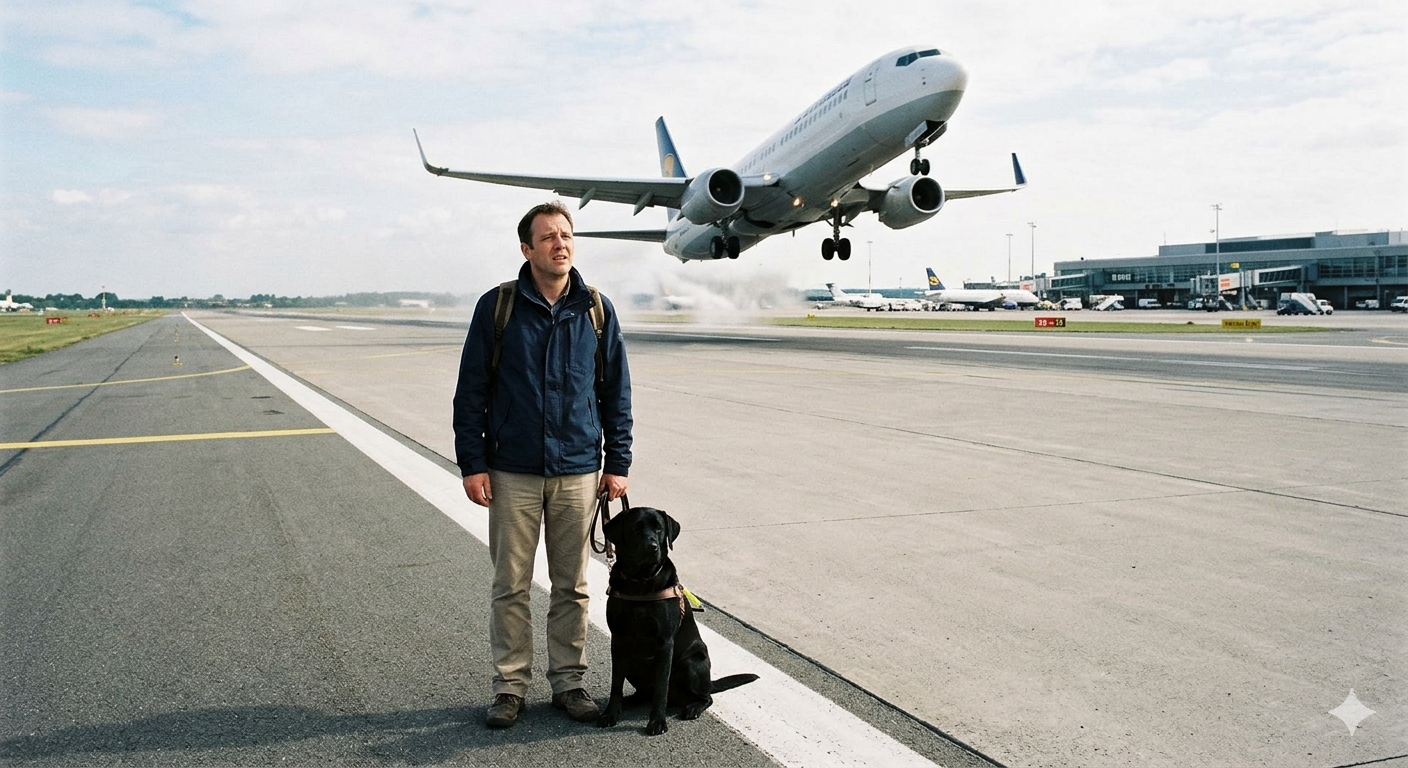
Tag: Denial

  • Systematic discrimination canadian airlines and service dogs

    Systematic discrimination canadian airlines and service dogs


    DATE: April 15, 2026
    ATTN:


    Hon. Steven MacKinnon | steven.mackinnon@parl.gc.ca
    CC:
    Hon. Kelly Mccauley | kelly.mccauley@parl.gc.ca
    Hon. Mark Carney | mark.carney@parl.gc.ca

    RE: Systematic Discrimination Against Persons with Disabilities in Canadian Air Travel


    Dear Minister MacKinnon,
    It is with a profound sense of urgency and frustration that I write to you regarding the current state of air travel in Canada. For many Canadians, air travel is an essential service—required for maintaining family connections, accessing specialized medical care in other provinces, or participating in the national economy. However, for those of us living with disabilities, the experience of air travel is increasingly defined by systemic barriers and discriminatory practices.


    While recent public discourse has rightly focused on the unacceptable frequency of damaged medical equipment and mobility aids, there is a quieter, equally damaging form of discrimination occurring: the treatment of service and guide dog handlers by our national airlines. My recent and ongoing experiences with two of our major national carriers demonstrate that these are not isolated incidents, but rather a reflection of a flawed regulatory environment.
    It has become clear that in Canada, we have effectively created three distinct “classes” of citizenship regarding transportation:
    Able-bodied citizens: Who enjoy seamless, autonomous travel.


    Persons with disabilities who do not utilize service animals: Who face physical barriers but maintain some level of digital autonomy.
    Persons with disabilities who work with service or guide dogs: Who are subjected to invasive, inconsistent, and degrading bureaucratic hurdles simply for choosing a mobility aid that is biological rather than mechanical.


    Our national airlines have made travel for service dog handlers burdensome and emotionally exhausting. By imposing restrictive internal policies, they have effectively bypassed our rights to independence, autonomy, and dignity as protected under the Canadian Charter of Rights and Freedoms.


    To illustrate this disparity, I ask you to consider the following three scenarios:
    The Able-Bodied Traveler: Books a flight three months in advance. They receive a digital notification 24 hours prior, check in via their smartphone, receive an electronic boarding pass, and proceed through security to their gate with zero friction.


    The Traveler with a Disability (No Service Animal): Generally experiences the same digital autonomy as the able-bodied traveler, assuming no specialized physical assistance is required at the check-in counter.
    The Traveler with a Service or Guide Dog: Upon booking months in advance, they are mandated by airline policy to “apply” for travel at least 48 hours before departure. They must submit the dog’s height, weight, length, and girth, and provide “proof of task” or identification—documentation that is not even legally required or provided in every jurisdiction.


    The most egregious barrier, however, is the refusal to issue electronic boarding passes to service dog handlers. For those of us with vision loss, digital documents are a cornerstone of our independence. We use screen readers and adaptive technology to access information that sighted travelers take for granted. By forcing us to wait in line for a paper pass, the airlines are not only stripping us of our time but also our autonomy. We are then subjected to an “assessment” at the airport by airline staff who often lack the specialized training required to evaluate a professional service animal. We are not told who is assessing us or what criteria are being used, creating an environment of constant anxiety where our right to travel can be revoked on a
    I am exhausted, Minister MacKinnon. I am exhausted by the constant need to advocate simply to exist and move within my own country. It is dehumanizing to be told, through policy and practice, that my life and my travel are “less than” because my mobility aid has a heartbeat.
    We require immediate action and meaningful consultation. This consultation must involve disabled individuals directly, rather than relying solely on large organizations that may not represent the lived realities of independent handlers.
    Why is it that I can fill out a Department of Justice attestation form for the United States and travel with dignity, yet in Canada, I must plead for my rights every time I enter an airport? I urge your office to review the Accessible Transportation for Persons with Disabilities Regulations (ATPDR) and hold our national carriers accountable for these discriminatory practices.
    I look forward to your response and to hearing how your ministry intends to restore equality to the Canadian skies.
    Respectfully,
    Douglas Rudolph

  • Crew Talks Service Dogs & Uber / LYft

    Crew Talks Service Dogs & Uber / LYft

    Hi Guys! It’s your very fluffy boy, CREW!

    I’m off duty today, and I really needed to talk to you all about something super important that happens right here at home. My mom has been quite upset lately because of all the Uber and Lyft drivers in Edmonton who refuse to transport her and my sister. And honestly, I totally get why she’s upset, because the same thing happens to my dad and me on a disappointingly regular basis. It’s frustrating for my whole family!

    So, let’s have a real chat and truly understand the problem.

    I’m Not a Pet, I’m a Professional!

    I’m not wearing it right now (gotta air out the fluff!), but I am a very proud professional. I am what you call a guide dog. I usually wear a special harness, which you’ll see later. My job is to guide my dad around all the obstacles, tell him where steps and curbs are, and make sure he doesn’t walk into anything. I take my job very… well… mostly seriously.

    Sometimes Dad is running late, or it’s dangerously cold, or it’s just easier to take a ride, so he books a Lyft or Uber. He tells me his paws get anxious every time because drivers constantly try to refuse us.

    Dad says that in Alberta, it is illegal to refuse access to a service dog or guide dog. He’s also told me that right here in the City of Edmonton, it’s against the Vehicle for Hire Bylaw. I don’t fully understand all the legalese, but I understand that refusing us is wrong, and there are serious consequences. I’ve also heard him and Mom talking about how it’s strictly against Uber and Lyft policies to refuse access to any of us service dogs.Allergies & Fears: Let’s Get Real

    Allergies

    Now, I understand that some of you might be allergic to dogs. I totally get that. (Though, I’m slightly offended you’re scared of me—I mean, look at this fluff!) In all seriousness, if you are truly allergic, I can only tell you what the City of Edmonton requires: proof.

    You must provide the City of Edmonton’s Vehicle for Hire team with a valid, documented doctor’s note stating your allergy. If you have this documentation, here is the proper protocol:

    1. Upon arrival, if you see me or a dog like me, please immediately let my dad (or the other handler) know that you have a documented allergy.
    2. Put us back in the system to be dispatched to a different vehicle.
    3. Please stay with us until the other vehicle arrives. This ensures our safety and ensures that you do not face any repercussions for a refusal that is legally allowed only with proper documentation.

    Fears

    Your fear is valid; don’t let anyone tell you it’s not. I hear you, I respect you. But your fear of me is not a legal ground for refusing me service. I know you probably don’t know about all the intense training I’ve had, so let me tell you about what it takes to be this level of professional.

    My Resume: The Making of a Guide Dog

    I’m a guide dog, which means my journey started at the kennels of the amazing program that trained me (shout out to Guiding Eyes For The Blind!). After about two to three months, I went to my foster home. They made sure I was fully housebroken and went through rigorous obedience training. When you’re a service dog, there is no room for aggression.

    I then had to pass a really tough exam called the Public Access Test (some places call it Canine Good Citizen Testing). Passing this means I have proven I behave in a manner that is acceptable to access public spaces where regular pets are not allowed. At this point, I officially became a service dog.

    • Quick Fact: “Service dog” is the general term for any of us who are trained to perform a specific task to help a person with a disability. All guide dogs are service dogs, but not all service dogs are guide dogs. Once I’m a service dog and no longer a pet, it becomes even more illegal to refuse me!

    How to Tell If We Are Legit

    Now, I know you’re asking, “What do I do if I can’t tell if it’s a service dog, or if I suspect the handler is fibbing?” You’ll be happy to know that:

    1. It is illegal to claim you are disabled when you are not.
    2. You are only permitted to ask two specific questions to verify a service dog team.

    Question 1: Is that a service dog?

    If they answer yes, and you are still unsure, you can ask the next question.

    Question 2: What task is the dog trained to perform? (or “What task does the dog perform to assist you with your disability?” or “How does your dog assist you?”)

    These questions are all essentially the same and allow for your own wording. These are the only questions you are legally permitted to ask. This rule is pretty much North America-wide.

    If you drive in Canada, some provinces require service dogs to have ID cards, and you can ask for this proof. Just remember that not every team has these ID cards, as they may not be a resident of that specific province.

    My Final Plea to Drivers

    To every Uber, Lyft, and Taxi driver: All I ask is that you please do not call or consider me a pet.

    I am a service dog, and I have protected rights. I am permitted to go anywhere the general public is permitted. If you are driving your own car but providing a public service like rideshare, I am permitted to travel with my dad unless you have that documented allergy.

    I implore you: please take the mandatory training from the City of Edmonton and really read the Uber and Lyft policies. This will help you avoid being ticketed or having to go to court. This is a very real thing, and Dad and I have already had to go to court multiple times because of ride refusals.

    Nobody wants to go to court! It means a loss of money for everyone, and it could negatively impact your ability to drive.

    I know most of you are wonderful people, but for the few who want to refuse me, please don’t. I am a service dog; I am the equal of a person’s walker, crutches, cane, or oxygen tank. If you would not refuse a set of crutches, you cannot refuse me, either.

    Love,

    CREW (The Fluffiest Professional)