Contrast
Text

Tag: Service Dog

  • From Cane to Guide Dog 2.0: Lessons Learned About Myself

    From Cane to Guide Dog 2.0: Lessons Learned About Myself

    We all learn about ourselves as we navigate life’s various stages and experiences. This is especially true for those of us with vision loss who use canes, guide dogs, or both. This post reflects my personal journey as a cane user, a guide dog handler, and someone with fluctuating, unreliable residual vision.

    Lesson 1: I Over-Rely on My Sight

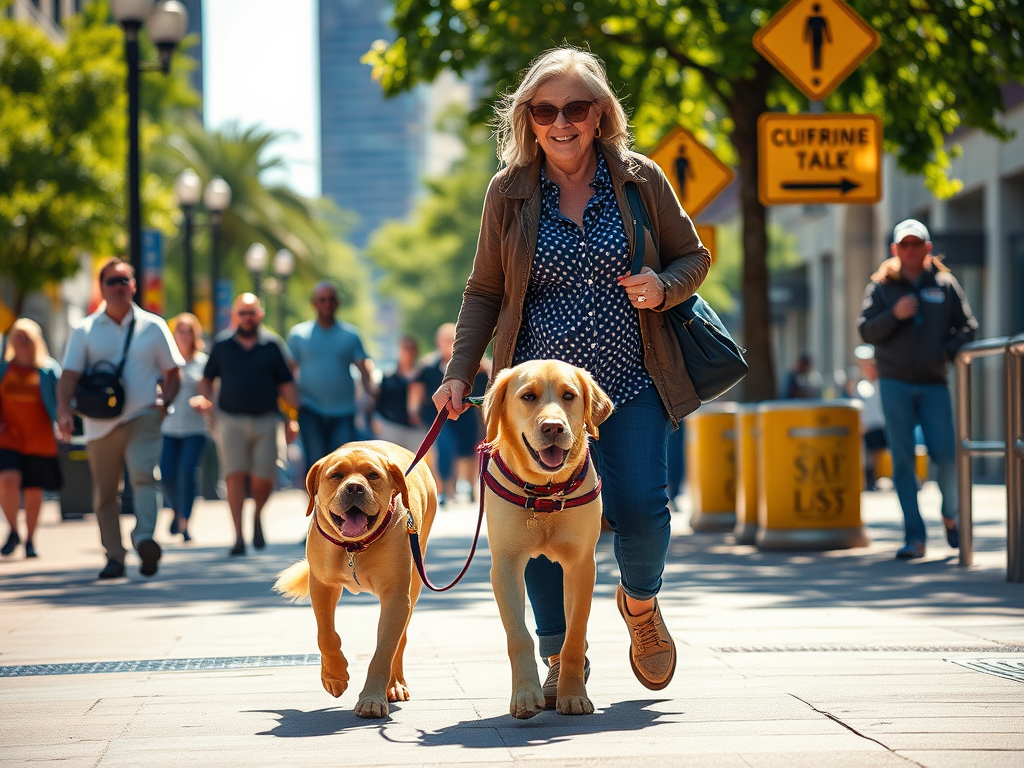
    This was a tough pill to swallow because I didn’t even realize I was doing it. For as long as I can remember, I used my vision to supplement my independent travel, hoping it would catch what my cane missed or identify obstacles at head level. I had no idea how problematic this was until I’d had my first guide dog, Indy, for about a year. We started having serious navigational issues.

    Indy, my first little yellow boy, was incredibly smart – almost too smart. The problem? My residual vision was interfering. Instead of guiding me around hazards, he was leading me towards them, walking me right on the edge of sidewalks, and generally making me feel unsafe. I contacted my guide dog program for help. During a session with a trainer, we discovered the root of the problem: I was using my vision, however limited, to override Indy’s trained responses and intelligent disobedience. He was doing his job, but I wasn’t letting him. This resulted in a massive communication breakdown and created dangerous situations.

    The takeaway? Just because you have some residual vision doesn’t mean you should use it all the time. Sometimes, the best thing is to trust your dog and let them do what they’re trained to do. Use your vision sparingly, perhaps for identifying visual landmarks to aid in route-finding. With my second guide dog, I’ve noticed a huge difference when I consciously avoid using my vision. He navigates much more smoothly and confidently.

    The challenge is becoming aware of when you’re using your vision. It’s often subconscious. Those of us trained in Orientation and Mobility (O&M) who learned to use auditory, visual, and tactile cues together will likely struggle with this the most. It’s okay to have these moments of accidental over-reliance, but the sooner you recognize the pattern, the sooner you can prevent it.

    Lesson 2: Trust the Process (and the Dog)

    Related to the first lesson, I’ve learned the importance of trusting the process and, more importantly, trusting my dog. It’s easy to second-guess, especially when you’re used to relying on your vision. But a guide dog is trained to make decisions based on a wealth of information – scent, sound, and tactile cues – that we can’t access. When I try to “help” by using my vision, I often introduce conflicting information and confuse my dog. This not only disrupts their focus but can also undermine their confidence.

    Learning to let go and trust my dog has been a process. It requires conscious effort and constant self-monitoring. I have to remind myself that my dog is a highly trained professional, and I’m the amateur. The more I trust, the smoother and safer our travels become.

    Lesson 3: Communication is Key (Even Without Words)

    Effective communication is crucial in any relationship, and the bond between a guide dog and handler is no exception. While we can’t verbally communicate with our dogs, we communicate through subtle cues – leash pressure, body language, and even our emotional state. Learning to read my dog’s cues has been just as important as him learning to read mine. He tells me when he’s unsure, when he’s detected a hazard, and even when he’s just feeling playful. Learning to listen to these nonverbal cues has strengthened our bond and improved our teamwork.

    Lesson 4: Patience is a Virtue (Especially with Yourself)

    Learning to work with a guide dog is a journey, not a destination. There will be good days and bad days, moments of frustration and moments of pure joy. It’s crucial to be patient – not just with your dog but with yourself. It takes time to build trust, develop effective communication, and learn to navigate the world as a team. There will be setbacks, but it’s important to remember that progress isn’t always linear. Celebrate the small victories, learn from the mistakes, and keep moving forward.

    Lesson 5: Adaptability is Essential

    Life with a guide dog is full of surprises. Unexpected obstacles, changes in environment, and even the dog’s mood can impact a journey. Being adaptable and flexible is crucial. Sometimes, you have to change your route, slow down, or even take a break. Learning to roll with the punches and adjust to changing circumstances has made me a more resilient and resourceful traveler.

    Conclusion

    My journey from cane to guide dog (and now guide dog 2.0) has been a profound learning experience. It’s taught me about self-awareness, trust, communication, patience, and adaptability. These lessons extend far beyond navigating the physical world; they’ve enriched my life in countless ways. While there have been challenges, the rewards of working with a guide dog are immeasurable. The independence, companionship, and unconditional love they offer are truly life-changing.


  • The Erosion of Disability Rights: A Personal Reflection

    The Erosion of Disability Rights: A Personal Reflection

    While once it seemed that progress was being made towards acceptance and equality for people with disabilities, recent experiences suggest a troubling reversal. This personal reflection explores this apparent decline, focusing on societal attitudes, education, and employment. These observations are based on my own experiences and may not reflect the experiences of all individuals with disabilities.

    Society

    Technological advancements, such as AI and visual interpretation software, while promising, haven’t translated into true accessibility for many, particularly those with vision loss. While access to information and some products may have improved, crucial areas like point-of-sale systems, self-checkout kiosks, and food ordering systems often remain inaccessible. Negative encounters with service dogs, including outright refusals of service, persist.

    People using mobility devices like wheelchairs and walkers face similar challenges. Accessing buildings and stores is often difficult due to a lack of ramps, automatic doors, and accessible restrooms. Accessible transportation options are becoming increasingly unaffordable and unreliable, with fewer accessible cabs and inconsistent door-to-door transit services. The increasing number of ride-sharing services refusing passengers with service dogs, despite legal protections, further restricts accessibility. Instead of genuine inclusion, society often seems to be pushing people with disabilities further into the shadows, diminishing their autonomy and independence.

    Education

    The ongoing job action by school support staff in Alberta, including administrative assistants, education assistants, and specialized learning support workers, has a devastating impact on students, especially those with disabilities. These students are being denied access to vital educational support, hindering their learning and development. The lack of urgency from the government and school boards to resolve this strike underscores a disregard for the needs of these vulnerable students. The strike also creates a ripple effect, impacting families’ access to respite care. Many students are not receiving the necessary care, education, and independent living skills development they need to thrive. The long-term consequences of this disruption are deeply concerning .

    Employment

    My personal journey in the job market highlights the significant barriers faced by people with disabilities. During my university years (2012-2018), I struggled to find any employment, despite numerous applications. Six summers passed without a single interview. While internships with the Government of Saskatchewan in 2018 and 2019 provided valuable experience, the pandemic disrupted my career. After a period of unemployment, I secured a part-time internship with a non-profit, which ended after two years. Despite working with multiple employment agencies, finding stable employment proved incredibly challenging. My resume and skills were solid, yet employers showed little interest. Over three years, I applied for approximately 2,500 jobs and received only three interviews, ultimately landing my current role. This experience raises serious questions about systemic discrimination and the lack of opportunities for qualified individuals with disabilities.

    Conclusion

    The challenges I’ve described in society, education, and employment raise serious concerns about the true state of disability rights. Are we witnessing a decline in progress, with people with disabilities facing increasing marginalization? Why are human rights legislation and charter rights not being effectively enforced? What concrete steps can be taken to address these issues and ensure genuine equality and inclusion for all? These are urgent questions that demand answers and action.

  • The Hidden Burden of Guide Dog Users: Anxiety

    The Hidden Burden of Guide Dog Users: Anxiety

    While working with a guide dog has drastically improved my mobility and independence, there’s a significant downside that often goes unacknowledged: the constant anxiety surrounding transportation. This is a feeling shared by many guide and service dog users, and for some, it’s a major deterrent to even acquiring or retraining with a dog.

    The Source of the Anxiety

    Have you ever felt anxious booking a cab, rideshare, or even getting into a friend’s car? Many haven’t, but for those of us with guide dogs, this anxiety is a near-constant companion. While hailing a taxi can be somewhat less stressful, the dread associated with rideshares is often overwhelming.

    The root of this anxiety lies in the unfortunate reality that many rideshare drivers don’t believe they’re obligated to transport service or guide dogs and their handlers. They wrongly perceive it as their right to refuse us service. Despite numerous lawsuits against rideshare companies, this discriminatory practice persists, creating a significant barrier for those who rely on these services.

    The Illusion of Legal Protection

    While laws exist to protect our right to access public transportation with our guide dogs, the reality is often far from ideal. These laws, whether at the provincial, state, or national level, frequently lack effective enforcement. In my own jurisdiction, for example, three separate pieces of legislation are designed to protect guide and service dog users. However, two of these are practically unenforceable. Even when legal recourse exists, the process is often so complex and resource-intensive that many victims of discrimination don’t even attempt to pursue it. Police often lack the training or understanding to properly enforce these laws.

    The Bleak Reality

    The result is a disheartening situation. Guide and service dog users are left to constantly fight for their rights, often facing humiliation and feeling like a burden. We’re left stranded, feeling unsafe and apprehensive about what will happen next. This needs to change. People with disabilities shouldn’t be treated as second-class citizens by either our governments or the individuals providing essential public services. Why must we constantly defend rights that are already legally guaranteed? Why must we fight for the enforcement of laws that are already in place? The ignorance and unwillingness to uphold these laws are the real obstacles, and they create a significant and unnecessary burden for those who rely on guide and service dogs for their independence.

  • Service Dog Ride Refusal: A Frustrating Reality

    Service Dog Ride Refusal: A Frustrating Reality

    Many people are aware of the high rate of ride refusals experienced by service dog handlers using ride-sharing services like Uber and Lyft. I recently experienced this firsthand, and I want to share my story to illustrate the impact these refusals have. This incident occurred on January 31, 2025, in Edmonton, Alberta, where the temperature was a frigid -20C with blowing snow.

    I was leaving my union office, where I’ve been working temporarily during a school board support staff strike. Given the harsh weather and poor sidewalk conditions, I decided to book a ride instead of walking. Unfortunately, what should have been a simple ride home turned into a frustrating and disheartening experience.

    I was initially matched with a driver named Fateh. Upon arrival, he refused to transport me and my guide dog, claiming a “no dogs allowed” policy. He then proceeded to spread misinformation about Lyft’s policies, his supposed lack of English proficiency, and other excuses. When I attempted to show him my service dog identification card, which clearly outlines his legal obligations under provincial law, he drove away.

    The Impact of Refusal

    This refusal had a ripple effect. My guide dog sensed my distress, experiencing the same negative emotions without understanding or being able to alleviate the situation. The dog was also exposed to the increasingly cold and uncomfortable weather. Passersby witnessed the incident with visible confusion and a sense of helplessness.

    Personally, I experienced a range of emotions. Initially, I felt irritation at having to constantly defend my legal rights. This quickly escalated to anger—anger at the repeated refusals, the powerlessness to prevent them, and the fact that I was now stranded due to someone’s ignorance. Finally, I felt a sense of utter frustration and despair. What’s the point of fighting for change, I wondered? What’s the point of having legal protections if they aren’t enforced?

    The Aftermath

    This experience ruined the start of my weekend. It left me feeling psychologically drained, frustrated, and demoralized. Beyond filing complaints with Lyft (and receiving a paltry $10 credit for the inconvenience), I now face the added burden of filing a complaint with 311 for bylaw enforcement, a process that could involve a lengthy investigation and even a court appearance.

    The larger question remains: what will it take to create real change? What needs to happen for these companies and their drivers to respect the law and the rights of service dog handlers? I’m exhausted, frustrated, and frankly, sick of this constant struggle.

  • Why I Chose a Guide Dog: My Journey from Cane to Canine

    For those who are visually impaired, the question of mobility tools is a deeply personal one. Choosing between a white cane and a guide dog is a significant decision, and one I didn’t take lightly. I’ve been asked why I ultimately chose to train and work with a guide dog, and I wanted to share my reasons. It’s important to remember that my experience is unique to me, and what works for one person might not work for another. Thorough research and introspection are key to making the right choice for your own needs.

    The Cane Conundrum

    Before I had my first guide dog, I used a white cane, on and off. Living in a small town, it served its purpose well enough. However, moving to the city exposed its limitations. Suddenly, I was constantly bumping into things, jabbing myself in the stomach (ouch!), and replacing canes at an alarming rate thanks to people tripping over them. It was during this time that I was also considering furthering my education. The combination of increased collisions, painful jabs, and damaged canes, especially with the added stress of school, pushed me to explore other options. In the spring of 2011, I applied for my first guide dog.

    A World Transformed

    Training with my first guide dog was a revelation. It opened my eyes to just how much I hadn’t been noticing in my environment. So much information, so much unnecessary stress, simply melted away. Suddenly, getting from point A to point B was faster, more efficient, and significantly less challenging. The true impact of this change became even clearer when I retired my first dog. Navigating my own neighborhood with just a cane again was incredibly exhausting. I was shocked by how much energy it took, and how much freer I had felt with my dog. It’s hard to believe, but the four years I spent without a guide dog were, in fact, the most exhausting four years of my life.

    My Verdict: Freedom Over Fatigue

    So, where do I stand on the cane versus canine debate? For me, a guide dog is the clear winner. I choose the freedom of movement and the reduced mental burden that comes with it over the constant exhaustion and limitations I experienced with a cane. I’ll take the open road and the confidence a guide dog provides any day.

  • Service Dog Identification: Yay, No Way or Not Sure?

    Yay, It Is A Great Idea!

    So, many people know that I am against the concept of identification for service dogs in general; however, I do understand why it currently exists. So, lets do a dive into why I am actually all for the concept of ID for service dogs.

    This One Is For You OTSDs!

    Yes, I 100% agree that there has to be something that is in play to protect those with owner trained service dogs. Those of you have your reasons for going the rout of training your own dogs, and I respect that, I also believe that the current way of the world excludes you all from being or having the protections that you all should have, deserve and need! I also understand that for some of you, vesting, harnesses ETC may not be appropriate or necessary for the provision of tasks. This ID than just helps the general public understand that in fact your dog is a service dog. I Wish it was easier than this, but i understand it. I also understand that most of us who go through a program for our service dogs receive an ID card from the program, so this for owner trained dogs makes sense to me, and levels out the playing field.

    NO WAY, I HATE THE ID CARDS!

    Okay, so now I am going to dive into why I am so against the ID cards. This is going to be a lot, sooooooo I am sorry.

    • Breach of Privacy – We all have a right to maintain our privacy and not provide information that we do not desire; however, these ID cards force us into providing information about us and or our service dogs that the general public do not have the right to know. These are things such as our address, our dogs name(s) even our dogs micro chip numbers.
    • Disclosure of medical information – Though not explicit, one can infer more about our medical condition and why we require the service dog than we may desire to provide.
    • Legal protections – On paper, those of us with service dogs have protections; however, they are not enforced, nor upheld within court. Various provinces have enacted a variety of different legislations granting protection to those with service dogs. This is great, if they were upheld in court, enforced, and if law enforcement actually knew how to handle complaints under the service dog acts across Canada. If you are lucky enough to live in Ontario, they actually have legislation with teeth; however, this legislation is still frequently disregarded.
    • General Public – The general public are the number one reason that these pieces of legislation exist. With their constant attempts to “certify” their pets as service dogs, we are in a society where all dogs are in question, no matter their training, or legitimacy. This has created a culture of constant fear for those of us with legit service dogs, as we are constantly questioned, doubted, or accused of lying when we are questioned. Unfortunately, this has also created question within the service dog handler community about the legitimacy of some of our own dogs, other handlers dogs, ETC.
    • Public Policy – Let us take a look at public policies for a moment. I am going to use the city that I reside in as the example here.
      So, if you acquire a program trained service dog, you are obligated to be in possession of the service dog identification prior to being allowed to license your service dog. So, this results in the inability to follow civic laws for a period of time, resulting in potentially getting fined, and legally not permitted to take your service dog into public spaces.
      In addition to the above, transit operators are informed that they have the right to ask for identification for service dogs. The issue here is they are not trained as to what to ask for, and often are asking for things that legitimately do not exist or are completely illogical. For example, I have been asked for the “certification”. The dog is not certified the program in which issued my dog is certified. I have also been informed that operators have asked for the dogs “service dog tag”. What? Seriously? Even if this was a thing, why would we remove our dogs collar potentially relinquishing care and control over the dog, to prove it is a service dog? Does that not in of itself break the current legislation? These are just examples on how implementation of policy without training, or alignment with provincial legislation results in inadequate training of civil workers & discriminatory public policy. Now, I want you to think about what would happen if you do not reside in a province / country with identification requirements. Do you think you would be legally discriminated upon, or do you think that you would be safe? How would you handle a discrimination situation where you are granted the right to your service dog; however, the provincial legislation allows you without the regional ID to be discriminated upon?
    • Stop and ID – We are in a society where the police have across Canada been halting practices of “stop and ID”; however, as persons with service dogs, we are legally allowed to be stopped by facility operators, store managers / staff, security ETC and forced to present our service dogs ID. Could we not consider this to be equal to the practice of “stop and ID” that the various police departments previously did? Could we not consider this to be an invasion of privacy? What about breaching section 8 of the Canadian Charter of Rights and Freedoms? For reference this is the section responsible for unlawful search and or seizure and our protected right to privacy.

    So, What Now?

    Well, this is where it gets complicated. We do not have national legislation that protects service dogs and their handlers, rather we have provincial protections and they vary province by province. We need a legislative document to be put in place under the criminal code of Canada that outline the penalty for discrimination against a service dog handler, and that create a consolidation of various provincial legislations, all the while creating a set of laws that actually protect all of us living and working with service dogs, no matter the training processes that they underwent. By having provincial legislation that is not consistent with one another, or legislation that has no enforcement ability, or that is not upheld in the eyes of the court those of us with service dogs are going to continue not only being discriminated on, but constantly harassed by the general public if they do not believe we are entitled to or have a disability serious enough for a service dog. Currently we are judged within the society by the general public, and are required to provide the burden of proof that we are in fact disabled, or that our dogs are in fact legit. At what point do our laws actually grand those of us with service dogs true right to free movement, and right of protection under the laws of Canada, and provincial human rights laws?

    My Question

    If we as a society can create laws against speeding, hate speech, and rights protecting persons of various identities without the need for them to provide proof of identity, why can we not create laws that truly provide protection under law for those of us with service dogs? Remember true protection also means ability to enforce the law, and have appropriate imposable penalty under such law.

  • Where Is Your Dog

    “Where’s Your Dog?” & Other Questions I’m Tired of Answering

    You know that question. The one that seems to tumble out of people’s mouths whenever they see a blind person: “Where’s your dog?”

    It’s a question that often comes with an undercurrent of surprise, even pity. People seem to assume that every blind person must have a guide dog.

    But the truth is, it’s not that simple.

    Here are a few reasons why I might not have my guide dog with me:

    1. Injury:

    Let’s be honest, accidents happen. If I’ve injured my arm, leg, or shoulder, working with my dog can be dangerous for both of us. A recent cortisone shot in my Achilles tendon left me with a significant limp, making it difficult to maintain balance while guiding my dog.

    2. Weather Extremes:

    Extreme weather conditions can be challenging for both humans and dogs. I’ve set personal limits: below -25°C, my dog gets to decide if he wants to brave the cold. At -30°C or colder, he stays home. Similarly, in the summer, I let him decide above 25°C and keep him home above 30°C.

    3. Illness:

    Just like us, dogs get sick! If my dog is experiencing vomiting or diarrhea, he needs a day to rest and recover.

    4. Not Everyone Has a Guide Dog:

    This is a big one!

    • Choice: Many blind people choose not to work with a guide dog.
    • Circumstances: Guide dog training is a significant commitment. It may not be feasible for everyone due to financial limitations, living situations, or personal preferences.
    • Independence: Some blind people prefer to navigate independently using other assistive devices like canes or long canes.

    Please, Respect Our Choices

    It’s important to remember that blindness is a diverse experience. Each person navigates the world differently.

    Ultimately, it’s about respecting our independence and our right to choose how we live our lives.

    Disclaimer: This blog post reflects the author’s personal experiences and opinions.

    I hope this helps! Let me know if you have any other questions.